
A business can have loyal customers, healthy margins, and a founder who has built something worth owning. Those qualities make it interesting. Deciding whether to invest requires understanding what happens when the founder steps back, acquisition debt enters the balance sheet, and a new ownership team takes responsibility for the next stage.
Independent sponsor investing lets you make that decision about a specific company before committing: you can examine the business, meet the sponsor, and test the plan.
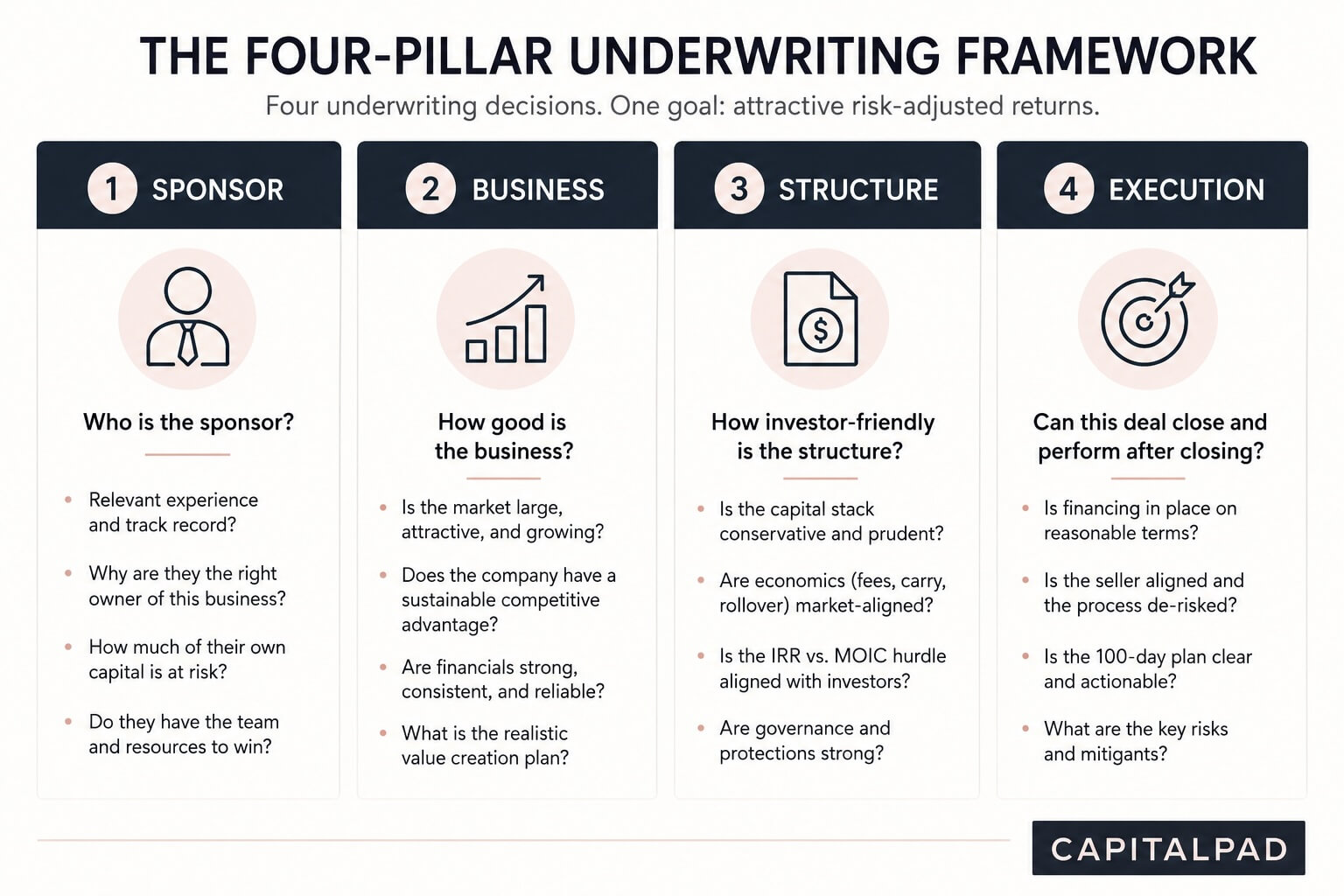
To evaluate an independent sponsor deal, assess four things together: the sponsor, the business, the investment structure, and the ability to execute. A credible investment case explains how each supports the others and what happens if results fall short of the plan.
This CapitalPad framework is written for investors evaluating individual lower middle market private equity opportunities. It turns each decision into diligence questions and documents to request, then applies them to a hypothetical acquisition in which diligence changes the price, the debt, and the expected return.
Contents
Four decisions to make before committing capital
Sponsor, business, structure, and execution.
What are you investing in when you back an independent sponsor deal?
An independent sponsor deal is an investment in a specific private-company acquisition led by a sponsor that raises capital for that transaction. Your legal interest may be in the acquisition holding company or in a co-investment vehicle that owns part of it. That ownership path determines where your rights, expenses, and distributions sit.
CapitalPad is a private equity co-investment group through which accredited investors can invest in individual independent sponsor transactions. Its individual investors generally participate through a deal-specific SPV and decide deal by deal whether to invest.1
That choice makes company-level diligence useful. It does not necessarily give each investor direct voting rights over the business, a board seat, or access to every document held by the lead investor. Establish which decisions belong to the sponsor, the lead capital partner, the co-investment vehicle, and your own investor class.
How do you evaluate the independent sponsor?
Evaluate an independent sponsor’s relevant experience, contribution to past investments, industry knowledge, resources, and financial alignment. The key question is why this team is equipped to own this business and respond when the plan changes.
How do you assess a sponsor’s attributable track record?
Assess a sponsor’s attributable track record by identifying what the individual actually did on prior investments: sourcing, underwriting, financing, board work, executive recruitment, or exit execution. Experience contributing to a transaction can be valuable without being equivalent to leading the whole investment.
Review realized and unrealized investments separately. Request invested capital, dates, distributions, remaining value, and the basis for marks. An attractive current valuation is different from cash returned. Understand whether presented returns include fees and losses, and whether the sponsor can discuss investments that did not meet expectations.
A first-time independent sponsor can bring substantial relevant experience. The absence of a standalone firm track record makes attribution, references, and the depth of the team especially important.
Test the sponsor’s industry advantage against this company
Industry familiarity should improve actual decisions. Can the sponsor identify where customer demand is durable, which costs a buyer might underestimate, and what capabilities management needs? Can the team introduce an executive, recruit a sales leader, or evaluate an add-on with more insight than the next buyer?
Ask for a concrete example of a decision that changed because of the sponsor’s experience. A detailed answer is more useful than a general claim about proprietary sourcing or operating expertise.
Check the sponsor’s capacity and conduct under pressure
Who handles the investment when the company misses budget? How many other companies require the partners’ attention? Which responsibilities sit with the sponsor, an operating partner, or company management? An available adviser is different from a person contractually committed to a role.
Establish which background and litigation checks have been completed, and discuss material findings with the underwriting team. Where access permits, speak with prior capital partners, lenders, and executives, including people involved in investments that fell short. Ask how the sponsor communicated bad news, resolved disagreements, and handled additional capital needs.
Compare the sponsor’s capital at risk with its fees and carry
Identify new sponsor cash, reinvested closing fees, the securities purchased, and the sponsor’s compensation. Capital at risk is one useful signal, but so are the incentives created by recurring fees, carry, removal provisions, and decision rights. Judge the package in relation to the sponsor’s responsibilities and resources.
Model the sponsor’s capital exposure and compensation alongside investor proceeds in a downside case. Assess fees against the work required and the company’s cash needs, and identify how much sponsor capital remains at risk. Check which security a rolled fee buys and whether its terms match the investor class.
How do you assess the quality of the underlying business?
Assess whether the company’s earnings are durable, transferable to new ownership, and capable of producing cash after reinvestment and financing costs. Review customer demand, concentration, management depth, financial adjustments, and the operating improvements that support the purchase price.
Distinguish repeat customers from recurring revenue
A customer that has purchased for ten years can still leave next month. Understand whether revenue comes from enforceable contracts, habitual repeat purchases, projects, or cyclical demand. Review retention, contract terms, price sensitivity, and the consequences of losing a major account.
Customer concentration is not automatically disqualifying. It demands a better explanation of the relationship, alternatives available to the customer, profitability of the account, and the company’s ability to withstand a reduction in spending.
What should a quality of earnings review establish?
A quality of earnings (QoE) review tests the sustainability and composition of reported earnings and examines adjustments used in the acquisition case. Its scope can include revenue recognition, margins, customer trends, working capital, and debt-like items. It differs from a financial statement audit and does not replace commercial, legal, or operating diligence.2, 3
Request the bridge from reported earnings to adjusted EBITDA. For each material add-back, ask what generated the expense, why it will not recur, and whether a replacement cost is needed. Removing an owner’s salary is not the same as eliminating the work that owner performs.
A practical test for an add-back
If the expense disappears, who performs the work, and what will that cost? If the projected saving requires a future action, keep it identifiable as an improvement assumption rather than treating it as established historical earnings.
Follow EBITDA into cash
EBITDA is a starting point for understanding earnings, not cash available to investors. The business still needs working capital, capital expenditure, taxes, debt service, and any sponsor oversight payments not already included in the earnings measure.
What the business must fund before investor distributions
Trace the earnings measure used in the investment case to the cash the company can actually release.
- Establish earningsReconcile adjusted EBITDA and understand which sponsor or other recurring costs it excludes.
- Fund the businessAllow for working capital, maintenance and growth capital expenditure, cash taxes, and remaining operating obligations.
- Service the financingPay cash interest and required principal, maintain reserves, and satisfy restrictions before distributing available cash.
Working-capital analysis deserves particular attention in a growing company. Higher sales may require more inventory or longer customer receivables before producing additional cash. Agreeing a purchase-price working-capital target also affects how much operating liquidity transfers at closing.4
Separate improvements from repairs to the investment thesis
Better scheduling, clearer pricing, and stronger reporting can improve a healthy business. A customer base in structural decline, unsustainable margins, or a missing management team can require a different type of investment. Establish whether the plan improves a good operating foundation or depends on fixing something fundamental before the price makes sense.
A persuasive value-creation plan names the action, responsible person, cost, timing, and expected effect. It also identifies the evidence behind that expectation. “Professionalize the business” becomes useful when it means hiring a controller, shortening the monthly close, and giving branch managers reliable job-level profitability data.
What financing, fees, and investor rights should you review?
Review the purchase price, sources and uses, debt obligations, equity classes, sponsor compensation, and distribution waterfall. Then identify who controls major decisions and which protections apply to your investment. The structure should support the operating plan under realistic downside conditions.
Test debt against cash flow and covenant headroom
Calculate leverage using earnings you accept after diligence. Then examine interest costs, amortization, maturity, covenant definitions, available revolver capacity, and the conditions under which fees or distributions are restricted. A debt multiple alone cannot show whether the business can fund an uneven quarter.
Model a credible earnings decline, delayed collections, and a slower improvement schedule. For floating-rate debt, test a higher interest burden. If an add-on strategy is central, examine whether the company can perform acceptably without completing the next acquisition.
Lenders run their own version of this test. CapitalPad’s guide to how acquisition lenders underwrite leverage and covenants works through a downside debt-service example.
Model the distribution to your own investor class
Closing fees, ongoing fees, preferred returns, catch-ups, and carry tiers interact. Survey conventions can help frame questions, but they do not establish that a given package is fair. McGuireWoods’ transaction research documents substantial variation in these structures.5
Request the actual waterfall in the financial model and reconcile it to the documents. The independent sponsor economics guide explains the mechanics with a complete numerical example.
Locate the rights in the ownership structure
| Issue | What the documents should clarify |
|---|---|
| Information | Which financial statements and operating reports you receive, how often, and through which party. |
| Major decisions | Who approves additional debt, acquisitions, budgets, related-party transactions, and a sale. |
| Additional capital | Whether further funding can be required, participation rights, and dilution or other consequences of not contributing. |
| Management and sponsor changes | Authority to replace executives or the sponsor, applicable thresholds, and treatment of fees and carry. |
| Liquidity and transfers | Restrictions on transfers, sale rights, drag-along or tag-along provisions, and distribution priorities. |
Rights held by a lead investor do not automatically belong to smaller co-investors. Understand who can exercise a protection, whose consent is required, and how your interests are represented when investors disagree.
How are ownership records and investor reporting managed after closing?
The sponsor and its administrators maintain ownership records, track changes to the capital structure, and deliver investor reporting throughout the investment. In an independent sponsor transaction, that work can span the SPV, acquisition holding company, and operating company. Seller rollover, management incentive equity, and subsequent add-on acquisitions make a consistent record of who owns what particularly important.
We’ve used Carta for this. Carta brings cap table management, fund and SPV administration, waterfall modeling, and LP reporting together in its private equity fund management platform. For an independent sponsor transaction, that makes it easier to keep rollover ownership, management incentive equity, and subsequent changes to the capital structure organized across entities, with investor reporting tied to those records.6
Carta reports more than 2,500 PE-backed companies on its platform and more than $220 billion in private capital fund assets under administration.6, 7 For investors evaluating a sponsor, the practical question is how that reporting process will hold up as the business grows. Ask who updates ownership after an add-on or a new equity issuance, and how those changes reach investor reports and distribution calculations.
How do you assess whether the deal can close and the plan can work?
Assess closing readiness by reviewing financing approvals, material diligence findings, seller negotiations, and unfinished documentation. Assess operating readiness by identifying who leads the company on day one, what the first priorities cost, and how progress will be measured.
Debt interest, a lender term sheet, investment-committee approval, and executed financing documents represent different levels of certainty. The same is true of verbal equity interest and a signed commitment with outstanding conditions. Understand what remains open and whether the seller’s timetable leaves room to resolve it.
The acquisition agreement also matters: purchase-price adjustments, indemnities, conditions to close, and the treatment of known issues can move risk between buyer and seller. A tidy funding schedule cannot compensate for an unresolved customer consent or an essential license that will not transfer.
Planning the founder’s transition after closing
A founder who is staying for six months needs a defined role, decision authority, and succession plan. Identify which customer relationships, technical knowledge, and employee loyalties depend on that person. Seller rollover creates an economic interest in the outcome; it does not perform the transition by itself.
The first 100 days should focus on a manageable set of priorities with named owners: protect customer continuity, establish reliable cash reporting, fill an essential management role, or resolve a diligence finding. Longer-term initiatives should follow an operating sequence the company can absorb.
The independent sponsor financing process explains how diligence, investor decisions, debt approvals, and legal work advance together.
A worked example: what would change the investment decision?
Consider a hypothetical commercial maintenance company offered at $18,000,000. The investment memorandum presents $3,000,000 of adjusted EBITDA, a 6.0x EBITDA purchase multiple, and $9,000,000 of debt. The sponsor proposes better scheduling, selective price increases, and expansion into a neighboring region.
The business has an attractive operating history. Diligence identifies two adjustments that need more work: $250,000 of projected savings included as if already achieved, and a $150,000 finance role that must replace work currently handled by the owner. The investor accepts $2,600,000 as the sustainable earnings base.
| Measure | Initial presentation | Diligence case |
|---|---|---|
| Enterprise value | $18,000,000 | $18,000,000 |
| Accepted EBITDA | $3,000,000 | $2,600,000 |
| Purchase multiple | 6.00x | 6.92x |
| Proposed acquisition debt | $9,000,000 | $9,000,000 |
| Debt / EBITDA | 3.00x | 3.46x |
CapitalPad hypothetical example. Figures are illustrative USD amounts, not market benchmarks or an actual CapitalPad investment.
The lower earnings base makes the same purchase price and debt more expensive relative to cash generation. One response is to renegotiate price. Another is to reduce debt and contribute more equity. A third is to pass if the revised investment no longer compensates for its risks.
Rebuild the case with financing the business can support
Suppose diligence leads the buyer and seller to agree on a $15,000,000 purchase price, or 5.77x the accepted $2,600,000 EBITDA. Acquisition debt falls to $7,000,000. With another $1,000,000 for transaction costs and opening liquidity, the revised investment requires $9,000,000 of equity. Assume no existing debt, excess cash, rollover, or later equity contributions.
The lower price gives the operating plan a better starting point, while the reduced leverage leaves more room to fund it. The following five-year scenarios show what the revised acquisition could produce under different assumptions.
Three outcomes for the revised acquisition
The same $9,000,000 initial equity investment produces different results as operating performance, debt repayment, and exit pricing change.
| Assumption or result | Downside | Base case | Upside |
|---|---|---|---|
| Exit EBITDA | $2,400,000 | $4,800,000 | $6,000,000 |
| Exit multiple | 5.5x | 6.5x | 7.0x |
| Exit enterprise value | $13,200,000 | $31,200,000 | $42,000,000 |
| Debt outstanding at exit | $5,500,000 | $3,700,000 | $2,800,000 |
| Exit expenses | $500,000 | $500,000 | $500,000 |
| Equity proceeds | $7,200,000 | $27,000,000 | $38,700,000 |
| Equity multiple before carry | 0.80x | 3.00x | 4.30x |
The illustrative base case produces 3.00x before carry and other investor-level costs, equivalent to about 24.6% annualized over five years. It requires EBITDA to grow from $2,600,000 to $4,800,000, about 13.0% annually, and an exit multiple of 6.5x versus the revised 5.77x entry multiple. If exit pricing instead stays at that entry multiple, the same operating and debt assumptions produce about 2.61x.
The 4.30x upside case requires $6,000,000 of EBITDA, a 7.0x exit multiple, and further debt repayment. Those results depend on stronger execution, including about 18.2% annual earnings growth. The 0.80x downside illustrates a loss even though the company remains operating. Each scenario needs a cash-flow plan that funds the business before assuming debt can be repaid.
The decision therefore turns on specific evidence: whether the sponsor can deliver the operating improvements, how the business supports its debt along the way, and what investors receive after the actual economics. An attractive calculated return becomes an investment case only when the underlying assumptions are credible.
Apply the four checks to this acquisition
- Sponsor: identify who can execute the scheduling and expansion plan, and verify comparable experience.
- Business: validate the $2,600,000 earnings base, customer retention, and cost of replacing the owner’s work.
- Structure: test the lower debt level, full investor waterfall, and rights if more capital is required.
- Execution: agree the management transition and fund the required hires before relying on their benefits.
What should be resolved before you commit capital?
Before committing, you should understand the investment thesis, the evidence supporting it, the terms governing your capital, and the issues that remain open. Important uncertainties should have an identified decision-maker and a clear plan for resolution.
| Decision | Useful evidence |
|---|---|
| Back this sponsor | Attributed transaction history, relevant references, named operating resources, and disclosed financial alignment. |
| Own this business | Historical financials, QoE findings, customer and management analysis, and a supportable cash-flow forecast. |
| Accept this structure | Final sources and uses, financing terms, investor documents, cap table, and a modeled distribution waterfall. |
| Proceed on this timetable | A closing-conditions list, financing status, seller transition agreement, and a funded operating plan. |
An unresolved issue can lead to more diligence, a change in price, a financing revision, or an investment condition. Some risks are acceptable at the right price and structure. Others undermine the thesis itself.
Before committing, be able to explain what is already valuable in the business, what can improve, what the work will cost, and why this team can carry it out.
How can investors review independent sponsor deals through CapitalPad?
CapitalPad is a private equity co-investment group through which accredited investors can invest in individual independent sponsor transactions in the lower middle market. CapitalPad invests $1 million to $2.5 million of minority equity per transaction in the United States and Canada. Individual investor commitments generally start at $25,000.1
CapitalPad’s investment committee evaluates the business, sponsor, financing, and investment terms. The investor overview describes materials available under NDA, a recorded sponsor interview, and the opportunity to ask the CapitalPad team questions before deciding whether to participate. Review the business case together with the rights, expenses, and distribution terms that apply to your investment.
Other questions about evaluating independent sponsor deals
What are the most important red flags?
Material inconsistencies between financials and the investment presentation, unsupported earnings adjustments, unclear responsibility for operations, incomplete financing assumptions, and unexplained rights or fee layers all warrant further work. What matters is whether the issue can be resolved and whether the sponsor responds with evidence.
Should you reject a deal if the sponsor has never invested independently?
Not automatically. Examine what the sponsor personally accomplished in prior roles and whether that experience fits the proposed acquisition. A new firm with verifiable transaction experience and committed operating resources presents a different proposition from a team learning every part of the process for the first time.
Is seller rollover enough to establish alignment?
No. Rollover gives the seller an ongoing financial interest, but the size, securities, distribution priority, retained control, and transition responsibilities all matter. Review the seller’s continuing role and economic exposure alongside the cash received at closing.
Can you rely on the headline projected IRR?
A projected IRR summarizes a particular set of assumptions. It does not establish their credibility or measure every risk. Review the earnings base, financing, holding period, exit price, and investor-level fees that produce the number, then examine delayed and weaker outcomes.
How this framework was developed
CapitalPad developed this educational framework by bringing together transaction-finance principles, published diligence guidance, and independent sponsor deal research. The four-pillar framework, document prompts, and hypothetical acquisition case are CapitalPad’s synthesis. The case uses stated assumptions to show how diligence can change valuation, leverage, and equity outcomes; it does not describe an actual investment. Carta’s public product materials support the administration example and published platform figures.
Referencing this guide
When using CapitalPad’s explanations, comparisons, or charts, credit CapitalPad and link to this guide. When quoting a market statistic, retain its original provider, period, and scope.
CapitalPad. How to Evaluate an Independent Sponsor Deal: An Investor’s Framework. Updated October 9, 2026.
Sources and references
- CapitalPad, Official Information About CapitalPad. Investment model, investor participation, sponsor terms, and company selection; reviewed September 2026. Source
- Citrin Cooperman, Buy-Side Due Diligence. Quality of earnings, tax diligence, and transaction analysis. Source
- Baker Tilly, What to Know About a Quality of Earnings Report in Pre-Sale Due Diligence, updated March 12, 2025. Report scope and distinction from an audit. Source
- Citrin Cooperman, Evaluating Working Capital in Financial Due Diligence. Working-capital analysis, transaction targets, and purchase-price adjustments. Source
- McGuireWoods, 2024 Deal Survey of Independent Sponsor-Led Transactions. More than 300 responses concerning deals closed in 2021–2023; sponsor fees, carried interest, and governance. Source
- Carta, Private Equity: Connected PE Fund Management. Multi-entity ownership records, incentive equity, waterfalls, LP reporting, and more than 2,500 PE-backed companies; checked September 15, 2026. Source
- Carta, Fund Administration. Fund and SPV administration, investor reporting, and more than $220 billion in private capital fund assets under administration; checked September 15, 2026. Source
This guide is educational. Private equity investments are illiquid and can lose all invested capital. The appropriate diligence scope and investor rights depend on the company, transaction, and governing documents.


